
Outdoor lighting installation, done the way your home deserves
Key Takeaways
- Professional outdoor lighting uses low-voltage (12-volt) systems that are energy-efficient, safe around water features, and designed to integrate with your home automation platform for full zone, scene, and schedule control.
- The most common mistake in residential landscape lighting is a single on/off schedule with no zones or scenes; a professionally designed system treats each area as an independent layer, controllable by time, activity, or environmental trigger.
- Professional-grade systems use brass or copper fixtures with lifetime hardware warranties and separately warranted LED modules (typically five to ten years) designed to be replaced without replacing the fixture, delivering 15 to 25 years or more of service.
- The right time to involve a lighting specialist is during the hardscape design phase — before pavers go down and trenches close — when running conduit costs a fraction of what it takes to disrupt finished landscape.
- A professionally installed outdoor lighting system is consistently ranked by real estate professionals as one of the highest-return exterior improvements, and a documented national-provider service history adds measurable value at the time of sale.
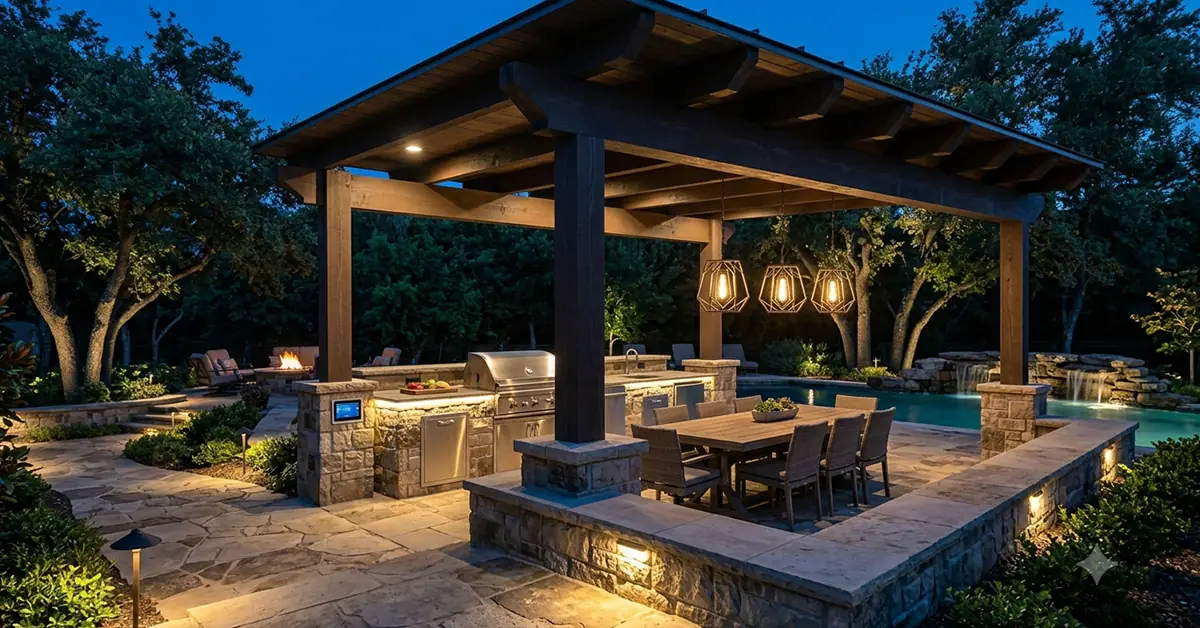
The best version of your home doesn’t stop at sunset. A well-designed exterior should transition naturally into the evening: architecture held in warm light, pathways clear without glare, the patio ready for dinner or a quiet drink without you touching a single switch.
Too often, though, outdoor lighting gets treated as a footnote. When it’s added as a last-minute afterthought — wire buried, transformer plugged into a timer — the result is a yard with exactly one mode: on at dusk, off at dawn.
That’s as limiting as it sounds. And for homeowners whose original installer has gone quiet or closed entirely, it’s often the moment they realize how little they actually got. A professional evaluation can reveal whether your existing infrastructure is worth refreshing or whether a full redesign is the better path.
What follows is what professional outdoor lighting installation looks like when it’s done right: the design thinking, the technical work, and the ongoing support that makes the difference between a yard that looks good in photos and one that works beautifully every evening.
What Outdoor Lighting Installation Actually Involves
Professional outdoor lighting installation is the strategic design and deployment of low-voltage cabling, load-balanced transformers, independent lighting zones, and architectural fixture placements to improve both the aesthetics and function of an exterior space.
That’s a lot of technical language, so here’s what each piece actually means:
- Low-voltage outdoor lighting runs on 12-volt power rather than standard 120-volt household electricity, making it energy-efficient and safe to work with around landscaping and water features.
- An outdoor lighting transformer converts the standard 120-volt supply down to 12 volts and acts as the central power hub for the entire system. Load balancing across the transformer is what keeps voltage consistent at every fixture.
- A lighting zone is a section of your exterior that can be controlled and scheduled independently. This means your driveway, back garden, and pool area can each behave differently throughout the evening.
- An outdoor lighting scene is a saved software setting that adjusts multiple zones and brightness levels at once to match a specific mood or activity, such as a dinner party, a late night, or a quiet Sunday morning.
- Color temperature is measured in Kelvin and determines whether your lights read as warm amber or cool daylight white. For residential exterior use, warm white between 2700K and 3000K is almost always the right call.
- Uplighting positions fixtures low and directs them upward to bring out the texture of trees and facades.
- Path lighting uses low-profile downward-facing fixtures along walkways to guide navigation. Done well, you see the effect on the ground and not the source in your eye.
One detail that surprises many homeowners: the fixtures themselves are architectural. Compact brass and bronze profiles patina naturally into plantings over time, disappearing by day while doing their work at night. This is a meaningful difference from the plastic stakes and aluminum heads in retail kits, which are hard to hide and harder to love.
Those fixtures also hold up differently. Commercial-grade brass and copper systems are engineered to last 15 to 25 years or more. Manufacturers warrant the brass housing for life; the LED light source carries its own separate warranty, typically five to ten years, and is designed to be replaced without touching the fixture. When an LED eventually dims, you’re swapping a module, not starting over.
“Outdoor lighting is a reliability nightmare for most homeowners. If the connections that get buried in the dirt are not done in a professional, specific way, they will deteriorate over time.”
Why One Mode Of Light Is The Most Common Installation Mistake
The single biggest error in residential outdoor lighting installation is leaving the entire property on one static schedule: on at dusk, off at dawn.
When lighting is added as a late-stage afterthought — wire buried without a controls plan, transformer set to a mechanical timer — that’s exactly what you get. Your yard isn’t a parking lot. Different areas serve different purposes at different times of the evening, and a single on/off trigger treats all of them the same.
“You need to light the yard like a room. You need layers of light where you have general lighting, specific areas that are highlighted, needs for different intensities and different zones to turn on and off.”
Imagine if every light in your kitchen and living room were either fully on or fully off together, with no ability to dim or adjust. That’s the experience most traditional landscape lighting delivers outdoors.
One practical note for anyone planning a renovation or new build: the best time to loop a lighting specialist into your project is before the hardscape is finished. Running conduit under a patio before the pavers go down costs a fraction of what it takes to cut through afterward. The installation begins in the design phase, not the finishing one.
Light Your Yard Like A Room: Layers, Scenes, And Zones
A well-designed landscape uses the same layered logic as a well-lit interior room, built from three distinct categories of light.
Ambient Lighting
This is the background layer. A soft overall illumination that establishes the mood and makes the space safe to move through. Think recessed deck lights, shielded downlights, and under-cap retaining wall fixtures. These typically run between 2700K and 3000K to keep the atmosphere warm and inviting.
Task Lighting
This delivers brighter, more focused light to areas where you actually do things such as outdoor kitchens, dining areas, and steps. Color temperature here can shift toward 3000K to 4000K where visibility matters more than ambiance.
Accent Lighting
This is where a property earns its visual character after dark. Directional spotlights, well lights, and recessed uplights showcase trees, architectural columns, and water features, giving the eye a path to follow and the property genuine depth.
Scenes
Scenes are what make the layers work together in real time. A "dinner party" scene might dim the pathway lights slightly, bring up a warm glow over the dining table, and activate subtle uplighting on surrounding foliage. A "late-night" scene could shift toward pathway-focused brightness while dialing back the decorative accents. Switching between them shouldn't require more than a tap.
Color Temperature
According to Houzz’s 2026 Outdoor Living Trends, designers are embracing warm, earthy outdoor palettes like rust, sage, warm terracotta, and natural wood. Cool or bluish light distorts these tones, making natural materials look flat and clinical. Warm white between 2700K and 3000K preserves texture and supports what designers call a biophilic environment, integrating natural elements like flowing water and living plants.
The distinction is worth understanding: 2700K (softer amber) suits homes with warmer architectural finishes — stone, terracotta, aged wood. At 3000K the light is slightly crisper, which reads better on contemporary and transitional homes.
To go deeper on how these design layers come together, our guide to smart home outdoor lighting covers the full approach to designing an exterior system with the same care you'd apply indoors.
How Outdoor Lighting Connects To The Rest Of Your Home
Modern landscape lighting is an entry point into your broader home system, and the installation process is the best possible time to think beyond the lights themselves.
“Once we’re running wire for all these lights, we run wire for speakers. Now you have wonderful sound, wonderful light levels and scenes. Outdoor sunscreens and screened-in porches, all motorized. As soon as we start talking to somebody about landscape lighting, it’s: you need Wi-Fi out there to control it all. You need music out there. You need screening.”
When trenches are already open and crews are already on-site, running additional conduit for outdoor audio, high-performance Wi-Fi access points, and motorized patio screens costs a fraction of what it would take to disrupt the yard again later.
Homeowners who’ve had systems installed in stages often describe the result as frustrating: multiple apps, multiple contractors, systems that don’t communicate. The alternative is a single, integrated environment in which lighting scenes, audio levels, motorized screens, and pool lighting are controlled by a single platform. Control4, Lutron, Savant, and Josh.ai each have strengths depending on the project’s scope, but the goal is the same: one interface, full control.
See how Daisy designs lighting that works with the rest of your home.
The integration conversation is also the right moment to explore outdoor entertainment more broadly. For more on how audio, shading, and lighting come together outside, this guide to elevating your outdoor experience with technology covers the full picture.

What A Professional Installation Timeline Looks Like
A professional outdoor lighting project moves through five phases, and knowing what to expect makes the process much less daunting.
Phase 1: Consultation and Planning (One to Two Weeks)
The project begins with an on-site visit to analyze the property’s topography, architecture, and planting. A detailed plan follows. For projects in the renovation or new-build phase, this is the moment to coordinate with the landscape architect or hardscape contractor; running conduit before the pavers go down is far easier than cutting through afterward.
Phase 2: Permitting and Sourcing (Two to Four or More Weeks)
Simple low-voltage systems often don’t require permits. Projects involving hardscape changes, structural pergolas, or significant grading may need municipal approvals, which can take a month or more. Local codes may also specify greater burial depth in freeze-thaw climates or where conduit runs under driveways. Your project manager will flag any requirements at this stage. Spring and summer lead times can stretch to six weeks, so early planning pays off.
Phase 3: Physical Installation and Cabling (One to Three Days)
Crews bury direct-burial wire at a minimum depth of six inches. This is deep enough to protect it from aerators, shovels, and lawn mowers, and to keep it clear of plant root zones in planting beds. A standard system of 15 to 25 fixtures is typically completed in a single day, though regional soil conditions affect timing. Cutting through limestone in Central Texas takes considerably longer than working with sandy soil in Florida.
Phase 4: Commissioning and Evening Adjustments (One to Two Nights)
Technicians return after dark to fine-tune fixture angles, balance brightness across the property, and program the lighting scenes within the home automation platform. This step is non-negotiable for a system that looks the way it should.
Phase 5: Proactive Support and Remote Monitoring (Ongoing)
This is where professional installation diverges most sharply from the alternative. It’s the part of the experience most homeowners don’t think about until they need it — and the part that separates an integrator who installs and leaves from one who stays.
“Our remote call center can log in, see the full status of your network, and handle fixes — like resetting your modem, pushing updates — without ever setting foot in your home. And then, if you need someone, they can dispatch someone who knows your home, and you know that person.”
How Much Does Professional Outdoor Lighting Installation Cost?
A professionally designed and installed outdoor lighting system typically ranges from $3,500 to $20,000 or more. This is a general range, however, final costs will depend on the structure of your home and project scope. Daisy does a complimentary consultation and on-site walkthrough before giving you a personalized proposal.
Several factors drive that range.
- Fixture count and placement. A focused front-of-home installation with 10 to 15 fixtures sits toward the lower end. A full-property design with independent zones for the driveway, garden, pool, patio, and architectural features requires more fixtures, more cabling, and more commissioning time.
- Fixture grade. Commercial-grade brass and copper fixtures cost more upfront than aluminum alternatives — and last dramatically longer. The premium typically pays for itself in the first replacement cycle you avoid. Consumer-grade aluminum and plastic fixtures typically fail within one to three years due to corrosion and voltage drop.
- Soil conditions and site complexity. Trenching through sandy Florida soil is fast. Cutting through limestone in Central Texas, navigating extensive hardscape, or working on a sloped property with retaining walls adds time and cost. Pools and water features add their own layer of specification.
- System integration. A system that connects to your home automation platform, manages outdoor audio zones, and handles motorized screening is a more involved installation than landscape lighting alone — and a more useful one.
There is no substitute for a site visit when it comes to arriving at a real number. Daisy’s complimentary consultation is the right place to start.
Ready To Transform Your Outdoor Space?
Your home has an evening life worth designing. The right outdoor lighting system doesn’t just look good in photos, it works quietly every night without you having to think about it. Architecture held in warm light, pathways clear, the patio ready whenever you are.
Ready to see what your exterior could look like after dark? Schedule a complimentary consultation with your local Daisy branch.