
How to Plan and Install an Outdoor Speaker System That Actually Sounds Right
Key Takeaways
- An outdoor speaker system is a permanent, weather-rated audio network that distributes sound across multiple outdoor zones, not just a pair of speakers bolted to a wall.
- Independent listening zones let each area play different music at different volumes, eliminating the hot spots and dead zones that plague single-speaker setups.
- Long-term reliability depends on IP-rated hardware, direct burial cable, and sealed connections. Standard electrical tape corrodes and fails within a single season underground.
- A professionally designed system lets you light and sound the yard like a room and connect to your smart home.
The patio furniture is set. The grill is going. Your guests have arrived. Then someone asks for music, and you spend ten minutes fiddling with a Bluetooth speaker that keeps cutting out.
A properly designed outdoor speaker system prevents this embarrassing situation. Did you know that 83% of renovated yards now include a dedicated lounge or seating area? The audio in these spaces deserves the same thought as the audio inside your home. This guide covers how to plan, zone, wire, and weather-protect a permanent outdoor sound system that actually performs when you need it.
What an Outdoor Speaker System Actually Includes
An outdoor speaker system is a permanent, professionally designed audio network that distributes sound evenly across outdoor living spaces. Unlike portable Bluetooth devices, it integrates weather-resistant speakers, dedicated amplification, and smart home controls to create tailored sound environments without visual clutter or sound bleed.
A complete outdoor audio setup is more than a pair of speakers. The full infrastructure includes source players, a multi-zone receiver, dedicated power amplifiers, weather-rated direct burial cabling, and network connectivity for streaming. Daisy's audio and video entertainment services are built around this complete-system model.
Start by Zoning Your Yard
Dividing your yard into independent listening areas, or zones, is the most important planning step in any outdoor audio setup. Each zone is an independently controlled section of your yard, with its own volume level and music selection.
Without zones, you're forced to set the volume for the farthest listener, which makes areas closest to the speakers uncomfortably loud while other parts of the yard stay quiet. Standard residential installs typically use two to four zones; estate-scale properties often span eight to 12.
“With traditional landscape lighting, you get one mode: on or off. A designed system lets you light and sound the yard like a room, with layers and zones you control independently. Because lighting wire and speaker wire run in the same project, outdoor audio is usually part of a larger zoned outdoor design. A covered dining patio, pool deck, fireplace lounge, and garden pathway can each become their own zone, playing different music at different volumes simultaneously.”
How Many Speakers Do You Need?
Distributed outdoor audio works on one core principle: more speakers at lower volume. As a baseline, we usually recommend:
- Installing one pair of quality outdoor speakers for every 200 to 400 square feet
- Placing speakers 10 to 25 feet apart, and never more than 40 feet apart
- Overlapping coverage footprints by 20% to 30% for smooth acoustic transitions in larger yards
Choosing the Right Speakers for the Space
Luxury homeowners prioritize discreet speaker designs that blend into the garden rather than competing with it. The right type depends on your yard's architecture and how visible the hardware can be.
Here are five common speaker types and where each can fit more naturally in your yardscaping so they aren’t an eyesore:
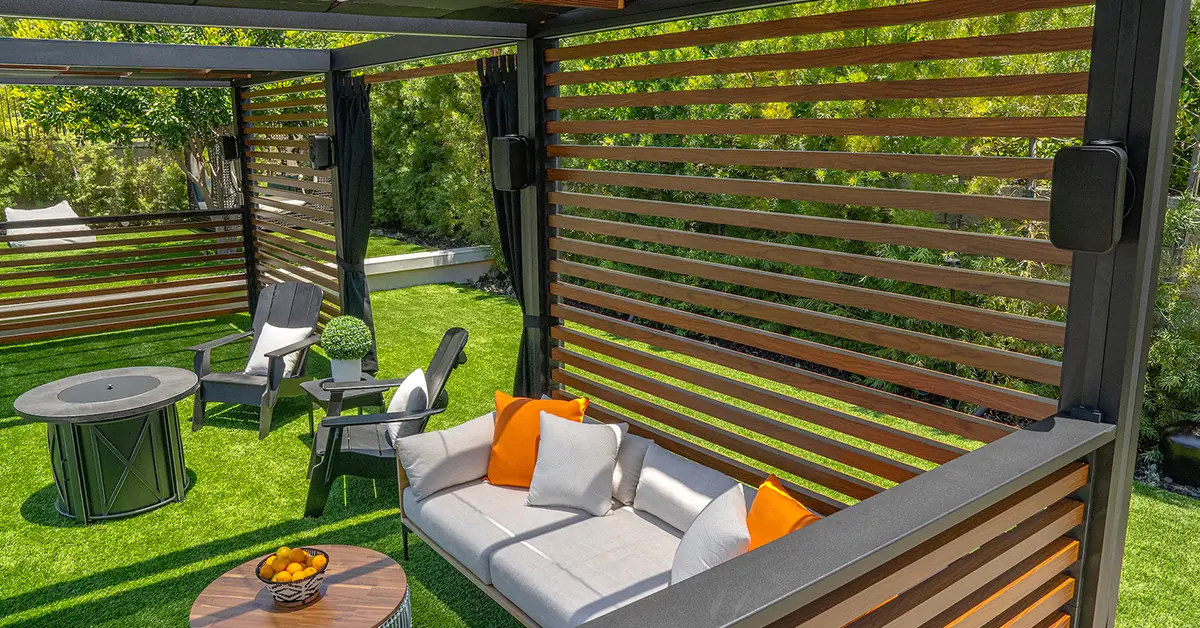
- Wall-mounted and eave speakers (such as the Sonance Mariner series): Ideal for covered patios, pergolas, and exterior home walls. Mounting brackets allow precise directional aiming, and nearby vertical surfaces naturally reinforce bass.
- In-ceiling marine speakers: Mount flush into covered porch and cabana ceilings for a hidden, clean architectural finish.
- Landscape and stake-mounted satellites: Compact speakers driven into the ground and hidden among flowerbeds and pathway borders, directing sound inward toward seating areas.
- Bollard speakers (such as the Coastal Source Ellipse Bollard): Free-standing column speakers ideal for pool areas and open lawns. The 47-inch models are partially buried underground, reducing visual height.
- Rock and planter speakers: Molded to replicate natural stones or garden planters, these blend into landscaped gardens so the technology disappears into the scenery.
For homeowners planning to pair a sound system with a projector screen setup, Daisy's audio and video solutions help you design an integrated, reliable system for indoor or outdoor viewing.
Step by Step: Installing an Outdoor Sound System
A successful outdoor speaker system installation addresses outdoor acoustic demands and protects hardware from the environment so you can enjoy it reliably, for years to come. Here are the four steps to installing your outdoor system:
Step 1: Map the system and plan cable paths. Before starting, map all listening areas, furniture, and landscaping. Run cable paths along garden borders or under mulch. Amplifiers and receivers go inside the home or in a ventilated, weatherproof enclosure.
Step 2: Choose the wiring standard. Two configurations suit different scales:
- 70-volt distributed systems: The signal is boosted to 70.7 volts, letting multiple speakers daisy-chain along a single cable run with minimal power loss over long distances.
- 8-ohm low-impedance systems: Each speaker runs its own cable back to the amplifier. It’s limited to shorter distances but delivers the highest fidelity and bass response.
Step 3: Mount and aim speakers. For wall-mounted speakers under eaves, the ideal height is 8 to 10 feet, angled 15 to 20 degrees downward toward the seating area. Under covered pergolas, keep speakers at least 12 to 18 inches from vertical walls to avoid reflections.
Step 4: Connect and test. Confirm and test your system, and adjust to optimize sound direction and volume.
Weatherproofing and Reliability
Outdoor audio equipment faces extreme stress: high heat, freezing temperatures, heavy rain, and insect or critter intrusions. Reliability depends on choosing the correct weather ratings and protecting cables and wire terminations. Here are three ways to protect your wiring:
- Look for official Ingress Protection (IP) ratings when selecting outdoor speakers:
- IPX4: Protects against water splashes from any direction, best for covered patios and shaded spaces
- IP55: Protects against low-pressure water jets and heavy rain, best for open patios and poolside areas
- IP56: Protects against high-pressure water jets, best for waterfront decks and sprinkler-exposed areas
- Consider suitability for direct burial cable underground. Standard indoor speaker wire can degrade rapidly below ground. True direct burial cables use a polyethylene jacket stable to -40°F, whereas standard PVC cracks at -4°F. Premium cable also includes water-blocking gels and moisture-absorbing yarns.
- Sealed connections prevent corrosion. Electrical tape and wire nuts should never be used in buried applications. Professional installers use silicone-filled wire nuts, adhesive-lined heat shrink, and PVC conduit buried 12 to 24 inches deep to prevent erosion.
Stary calls outdoor audio "a reliability nightmare" when buried connections aren't done correctly. DaisyCare covers quarterly connection checks and annual acoustic calibration to catch cable failures before hardware damage occurs.
Keeping the Sound Yours, Not Your Neighbor's
A common mistake we see in DIY outdoor sound system installations is making sound containment an afterthought. For your and your neighbors’ comfort, it needs to be a priority.
The most effective approach is to install more speakers at lower volume rather than fewer speakers using higher volume. Background music works best at 60 to 70 decibels, roughly the volume of a normal dining table conversation. Sound volume operates on a logarithmic scale, meaning a 10-decibel increase sounds twice as loud. Party music should stay below 80 decibels. Above 85 decibels, you risk both neighbor complaints and hearing damage.
Low-frequency bass presents a separate challenge: it travels omnidirectionally through soil, fences, and walls. For premium installations, Coastal Source's Sub/Zero subwoofer system uses digital delay and phase-cancellation software to neutralize escaping bass frequencies, keeping the physical impact of low-end sound contained within the listening zone.
Control, Streaming, and Integration
Modern outdoor audio systems are designed to connect with your smart home. Wi-Fi streaming has become standard, allowing music to reach speakers via Apple AirPlay and Spotify Connect without a phone nearby. Ideally, this integration means your music continues uninterrupted when a text arrives or your phone moves inside.
Tying the system to a platform like Control4 is where outdoor audio becomes genuinely impressive. A single voice command for "Sunset Cinema" can lower motorized screens, dim landscape path lights, activate outdoor heaters, and route movie audio to outdoor speaker zones, all at once. Systems with AI-assisted digital signal processing also adjust equalization automatically as wind, humidity, and crowd size shift the acoustic environment.
Daisy's audio and video entertainment services approach your sound system as part of a broader integrated design, not as a standalone product. We can integrate your entertainment systems within your wider smart home design, including the spaces you use outdoors.
DIY versus Professional Installation
A weekend project is reasonable for simple, surface-mounted speakers. A permanent, multi-zone outdoor sound system is a different undertaking and benefits from professional installation for maximum safety and system reliability over time.
Common hidden risks in DIY outdoor audio:
- Digging without a site assessment can rupture buried utility wires or irrigation lines
- Improperly sealed underground splices corrode within a single season
- Mismatched speaker impedance (balancing the electrical resistance of your signal source to match its destination load) causes amplifiers to overheat and burn out
A professionally integrated system provides precise speaker placement, clean cable routing, and ongoing preventative care. Licensed integrators calculate placement based on your yard's dimensions, furniture arrangement, and hardscape surfaces. Remote monitoring then tracks device temperatures and signal strength continuously, diagnosing problems before you notice them.
Ready to plan your outdoor audio setup? We can help you design an outdoor entertainment and speaker system that you can enjoy for years to come. Schedule a complimentary consultation with the Daisy team to discover what’s possible.
FAQs
How many speakers do I need for my backyard?
How many speakers you need in your yard depends on its size and zone count. One pair of quality outdoor speakers covers 200 to 400 square feet. Most residential installs run two to four zones, while larger properties plan for eight to 12.
How far apart should outdoor speakers be placed?
Outdoor speakers should be spaced 10 to 25 feet apart, never more than 40 feet apart. For large open areas, the overlap method positions speakers so their coverage footprints overlap by 20% to 30%, creating smooth, consistent sound as you move across the yard.
Are outdoor speakers waterproof or just water-resistant?
Most outdoor speakers are water-resistant rather than fully waterproof. IPX4-rated models handle occasional water splashes and are well-suited for covered patios. IP55 or IP56-rated models handle heavier rain and water jets, making them appropriate for poolside areas and exposed garden beds.
How do I enjoy outdoor music without disturbing the neighbors?
Should I install an outdoor speaker system myself or hire a professional?
DIY installation is workable for simple surface-mounted setups. For a permanent multi-zone outdoor sound system, professional installation helps avoid failures that can cause early system loss (severed utility lines, corroded buried splices, mismatched impedance), and long-term service through a plan like DaisyCare keeps it running reliably.